
Becoming Ourselves
Thoughts on a new collection of Suzuki Roshi's writing

I’d like to say a little something about a new collection of teachings by our first Ancestor in the West, Shunryu Suzuki Roshi. The title of the book is “Becoming Yourself: Teachings on the Zen Way of Life.”
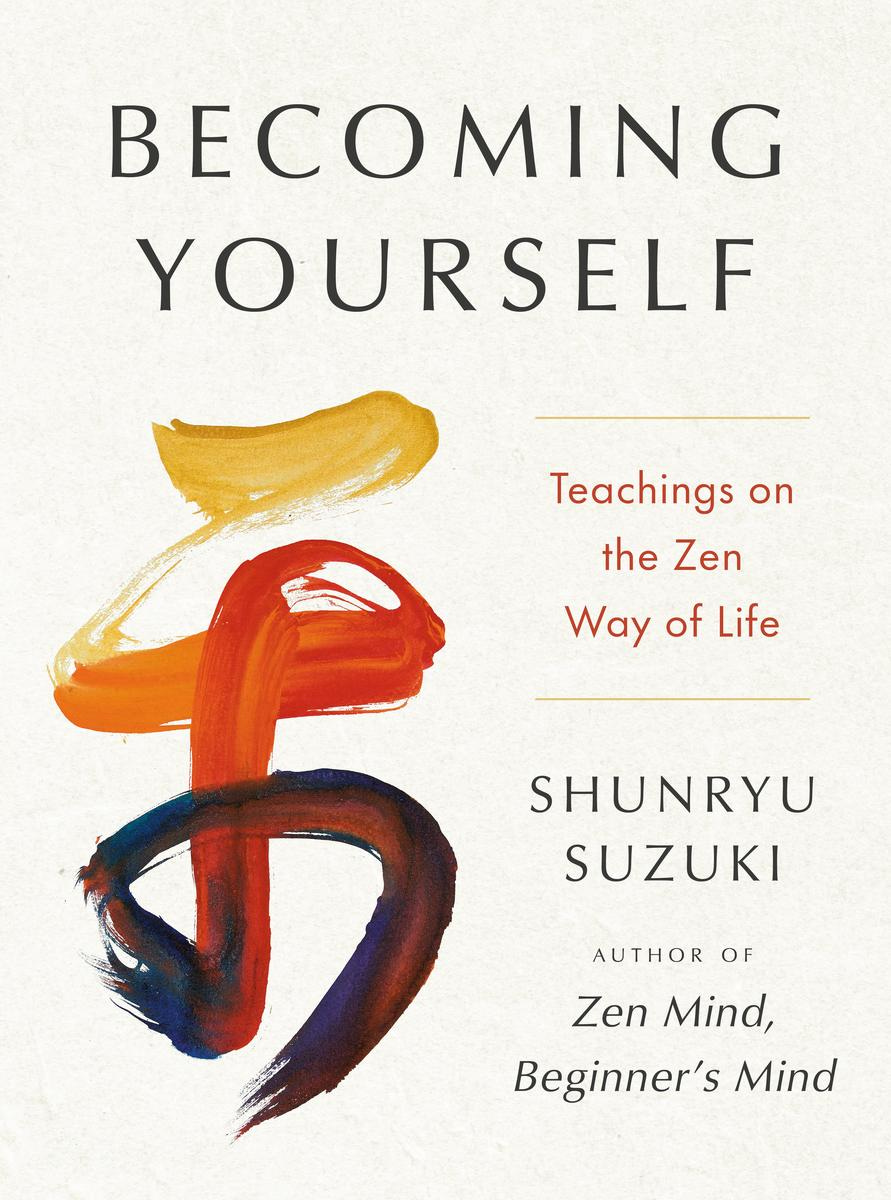
This new collection is a labour of love. The teachings included were selected and edited collaboratively by the late Sojun Mel Weitsman, one of Suzuki Roshi’s earliest students and the root teacher of Mountain Rain Zen’s Founding Teacher, Zoketsu Norman Fischer, and Jiryu Rutshman Byler, the abbot at Green Gulch in Marin County.
Jiryu introduced the book to us at the Branching Streams Gathering last fall, and he briefly discusses it in his introduction. He writes so sweetly about working with Sojun Roshi in his last years, “poring over the words of Sojun’s teacher and Jiryu’s grandteacher side by side, puzzling, appreciating, laughing, nodding - enjoying Suzuki Roshi and each other; understanding and also not understanding Suzuki Roshi and each other.”
As they worked, they began to focus more and more on Suzuki Roshi’s radical and warm perspective on morality and ethics, what we call the Bodhisattva Precepts.
Sojun Roshi felt that Suzuki Roshi’s understanding of the precepts was unusual, profound, and vital to understand and appreciate.
This book was finished after Sojun Roshi’s death in 2021, and I think completing this last great effort of Sojun’s was a very tender experience for Jiryu.
I strongly encourage folks to get a copy of this book if you can. Like Zen Mind Beginner’s Mind, it is a treasure trove for those of us who have been practicing for a little while, but also completely accessible and encouraging to people who are just starting out with practice. I suspect I’ll keep coming back to it.
Towards an Ethics of Becoming
Suzuki Roshi’s sense of the precepts really is quite unusual. In the West, I think our perspective on ethics - particularly in a religious context - is that we are given a bunch of rules and if we keep them we are good, and when we break them we are bad.
I was a devout catholic when I was young, and one of the most painful experiences of my early life was feeling the deep confusion and shame that came with feeling at odds with the precepts of my faith. I started to develop crushes on boys about the same time that rights for gay and lesbian people were being argued in Canadian courts, and in Church it was made very clear that things about me that I could not change were dirty and wrong. I remember listening to my Bishop give an interview on the radio, and going upstairs to take a shower, as if the water would clean off whatever had made me unacceptable.
Even the traditional instructions in Zen encourage us to loosen our grip on this strict view of ethics and conduct, to consider precepts and vows as opportunities to grow in awareness of our present circumstances, to become both wise and compassionate (including self-compassionate). The precepts are not hewn in stone and carved into the sides of courthouses - each student of Zen meets the precepts and works with them so that they make sense in their life.
This approach to ethics was one of the things that immediately attracted me to Zen practice. Ethics as exploration, in collaboration and conversation with the teachings.
But even by these standards, Suzuki Roshi flings us into strange territory. As Jiryu put it to us, for Suzuki Roshi, we practice the precepts by forgetting them.
Forgetting them doesn’t mean that the precepts don’t matter. The precepts are nothing other than our everyday practice, our everyday way of life, shaped by Zazen. In this way, the precepts are not just rules we follow in our day-to-day life; they are life itself.
“If the precepts are some moral code that you have in your mind, Suzuki Roshi has said, “those precepts don’t work at all. When you forget all the precepts and without realizing, without trying to observe them, as you eat when you are hungry, then naturally there are precepts. So when you forget all about precepts, and when you can observe them quite naturally – that is how you keep precepts.”
This is such a beautiful perspective, and I think it offers us two very important points to consider:
First, it is a kind of medicine for our tendency to use rules, especially religious rules, as just another way to hurt ourselves, to judge others, and to avoid our lives by living inside a reality that we have constructed with ideas about right and wrong.
Suzuki Roshi says:
As long as you live, you must eat something. After you eat, you may have a big rubbish pile of cans and wrappers. So, you should continuously work on it. You should clear your table every day. Even if you feel that you are clearing everything from your table, it must be done with the spirit of continuing to do so forever.”
“We should clear out our table everyday, and even when it is clear we should continue to make the effort to keep it clear. This is another important point. If you are cleaning your table because you think it is dirty, that mind is dirty. To think something is dirty means your mind is dirty. So we should let go of this kind of mind that discriminates between “dirty” or “clean,” “right” or “wrong.” - the point is to let go of discrimination.”
“The point is to clean things, not because they are dirty, but just because this is something we should do as long as we are alive.”
Second, this approach anchors us firmly in the incontrovertible and fundamental truth of our practice - that the only thing for us to do is to sit zazen as long as we are alive.
We are not practicing zazen like someone studying for a degree, so that after a few years we get a nice certificate that says “enlightened Buddha” and we can frame it and put it up on our wall and move on. We practice zazen like we eat food. Every day, repetitiously, and hopefully, with our full bodies, our full attention, and with delight.
To quote our school’s founder, Dogen, this is “not learning meditation, it is the Dharma Gate of repose and bliss.”
If it is not learning meditation, what is it we are doing when we practice zazen? Or practice the precepts?
Shunryu Suzuki says that “Our way of sitting is to become yourself.”
Katagiri Roshi always says, “to settle oneself on oneself.” to be yourself.
“When you become yourself, at that moment your practice includes everything. Whatever there is, it is part of you. You practice with everyone in the future or past. That is our practice.
Isn’t this wonderful? It is absolutely true - this practice, at its core, zazen and observing the precepts, is not about becoming someone else, memorizing complex or hidden teachings, or having some deep insight that makes us automatically and permanently wiser and better people.
One of my favourite things I do at Mountain Rain is offer zazen instruction to newcomers. With practice, I’ve been able to get my instructions down to 15 minutes. If you know how chatty I can be, you should appreciate what a huge achievement this is for me.
What I explain in those 15 minutes is the practice that has been handed down from ancestor to ancestor for thousands of years. There’s no advanced zazen masterclass revealing new techniques or premium zazen instruction for gold-class subscribers. What you learn in 15 minutes will take you your entire life to practice; it is inexhaustible, but after those 15 minutes, you will have everything you will ever need. Dharma talks, books, and dokusan are vital and supportive, but they are supplementary to this radically simple practice. Someone recently asked me how I can be relaxed talking about dharma in front of people, and it occurred to me that the background of anything I say into this little microphone is that it is less important than whatever happened to you in the two 25-minute periods of zazen before I started talking.
You already ate your vegetables. I’m just a little treat.
There’s nothing hidden about this practice. No big reveals.
This practice is to become ourselves, completely, and to take up the lifelong practice of resting in and investigating ourselves, knowing that the entire universe is included in that investigation, that the entire universe comes forward in the midst of that investigation.
When I started to practice Zen, I was really miserable. I struggled with a hatred of my body and myself that was so all-encompassing that I couldn’t even see it. It was just the landscape of my day-to-day life. This absence of self-regard had led me to completely identify with external validation. I had been a high-achieving student in the arts and philosophy, and had been admitted to one of the best law schools in the country. I thought that if I were materially and professionally successful, people would admire me, and somehow that admiration would be a balm for the deep sense of despair I felt within myself.
But of course, chasing external validation and the approval of others just exhausted me and made everything worse, and I eventually turned to zen practice as a way to finally try to settle in and make peace with myself.
Even so, I still hoped that Zen would take away the parts of me that were dirty or painful and deliver to me qualities that would make me happier, wiser, and more capable of love.
Even when the self-investigation of zazen started to reveal the gnarled roots of gender dysphoria that twisted around every part of my life, I still thought Zen would take it away from me and deliver peace.
It seems like such a simple, almost saccharine teaching for Zen to be about “becoming ourselves,” but actually, it is maybe one of the most radical ideas I have ever encountered.
It has taken me a decade to figure out that I’m not supposed to become a “better” or “wiser” person, but relax, bit by bit, into myself. To open my hands and my heart and trust my own life. And then, as Suzuki Roshi writes, “to share the feeling we have right here, right now” as a fundamental expression of Zen practice. To “share our feeling with people, with trees, and with mountains, wherever we are. That is Zen practice.”
Suzuki Roshi puts it in such simple, warm language, but this approach is deeply rooted in the teachings of our school’s founder, Dogen.
What Katagiri Roshi is saying, when he said, to settle oneself on oneself,” is a beautiful paraphrase of Dogen’s core teaching - Jijuyū Zammai or “Self Receiving and Employing Samadhi.”
In a collection of Katagiri Roshi’s talks, “Returning to Silence” we find a beautiful expansion of this statement:
Dogen Zenji emphasizes that zazen is not a means to an end, but that zazen is jijuyu samadhi. Ji means self, ju means receive, yu means use and samadhi means oneness. This means you receive your life and simultaneously the whole universe. That is why samadhi is translated into Japanese as “right acceptance.” Right acceptance is to receive yourself and simultaneously the whole universe. We have to receive the universe and use it. You are you, but you are not you, you are the whole universe. That is why we are beautiful. If we wholeheartedly paint a certain scene from nature on canvas, it becomes not just a portion of nature that we pick out, it represents the whole picture of nature. At that time, that picture becomes a masterpiece… Drawing one line is not one line, this one line is simultaneously the whole picture. That is called jijuyu samadhi.
Dogen was himself turning over the teachings of our zen ancestors:
As Master Rinzai said, “If you want to become the same as the Ancestors and the Buddhas, do not seek anything outside. The pure light of your mind is nothing but the Dharma-body of Buddha.” Or as Zen Master Hongzhi said, “it emits light and the great thousand worlds appear. Each and every thing in the world is nothing other than the realm of self-enjoyment of my self and its essential function.”
This is all very beautiful, but also very complicated, mysterious, and kind of mystical.
Which I like!
But it’s wonderful to have it put as simply and powerfully as Suzuki Roshi does here - our practice of zazen is simply, at its heart, to become ourselves completely, beyond being clever or ignorant, being good or bad. Just ourselves, with all of our troubles and traumas and quirks.
He writes, “A monk said to a zen master, “it is very hot! Is it possible to sit somewhere where there is no heat or cold?” The master answered, “when it is hot you should be hot buddha, when it is cold you should be cold buddha.” This is Dogen Zenji’s understanding of the story. In the usual story, the Master said, “when it is hot you should be killed by the heat. When it is cold you should be killed by the cold.” But if you say “killed,” the “killed” is extra. If you say to “attain” enlightenment, the “attainment”is extra. Dogen zenji was very direct when he said, “When it is hot you should be a hot buddha. When it is cold you should be cold Buddha.” That is the meaning of just sitting. When your practice is not good, you are a poor Buddha. When your practice is good, you are a good Buddha. Poor and good are themselves Buddhas. Poor is Buddha and good is Buddha and you are Buddha also. Whatever you think or say, every word becomes Buddha. I am Buddha. I is Buddha and am is Buddha and Buddha is Buddha. Buddha. Buddha. Buddha.”
One question that arises for me, when I think of practice as “becoming myself.” is whether that fits with all the zen teachings that instruct me to throw away ideas about myself, to become the “true person of no rank.”
So it was surprising to me that Dogen actually challenged the idea of becoming the person of no rank (mui-shinjin) and suggested a counterbalance. That to become a full human being is to become the “person of particularity or thusness (immo-nin). The practice that Suzuki Roshi is suggesting in his simple way is not to become nobody, but to see everything we meet in our lives - both the internal feelings, sensations, and thoughts, and the external experiences, struggles, and joys - as a full expression of the entire universe. Personal and social conditions are the medium through which we engage the interpenetrating totality of all life. Not freedom beyond our circumstances, but freedom in the midst of our unique circumstances.
Or, as Dogen puts it, “it is like someone who has fallen to the ground relying on the Ground for getting back up.”
However, when we practice being a person of thusness, understanding that just this moment, no matter how small or ordinary it is, contains the whole universe, the person of no rank is contained within that. We’re coming to the same mountain from the other side.
What does it mean to become yourself?
Suzuki Roshi’s “just becoming yourself” is not a kind of intellectual, directed self-investigation. It’s not taking a personal inventory. We’re not taking BuzzFeed quizzes or figuring out what our astrological signs are.
Of course, I know that, as a typical Sagittarius sun, Pisces moon with her Mercury in Scorpio, I don’t put a lot of importance into what my horoscopes say.
Becoming ourselves, investigating ourselves, is just the practice of meeting ourselves in zazen, and carrying that attitude out into the everyday situations of our life.
Suzuki Roshi says
After seeing his reflection in the water, Tozan Zenji wrote an enlightenment verse:
“Don’t try to seek yourself.
Don’t try to figure out who you are.
The ‘you’ found in that way is far from the real you;
It is not you anymore.
But when I go my own way, wherever I turn, I meet myself.”
This verse means you must find yourself in each zazen period. When you take your own step, then wherever you go, you will meet yourself. That is the bodhisattva way. You may think that you can figure out who you are by looking at your reflection in the water. Tozan Zenji says that although the image you see there is not you, what you see in the water, as it is, is actually you yourself. In the Hyokyo Zammai, Tozan Zenji makes the same statement: “You are not it; it is you.”
“He uses a paradoxical statement like this to catch your mind. It means that when you try to figure out who you are, even if you see yourself in the mirror, that reflection is not you. But if you just see your image in the mirror, without any idea of trying to figure out what you are, that is you yourself. When you try to figure out who you are, you are using your self centered, limited mind, and it doesn’t work. If you try to attain enlightenment , or to become some great Zen Master, you cannot. Before you practice our way, you are Buddha. But when you practice in a small, self-centered way, you will lose yourself.
I really love this. I’ve talked before about how dysphoria badly warps my perception of myself, and how often this shows up for me when I see my reflection. I’m never just looking. I’m always searching for something specific - the parts of my face that give me away, or that look ugly and might disgust others.
In those rare moments when I can just catch myself, to see myself without some idea, I sometimes can appreciate myself as a precious person who deserves to live, who deserves to be loved.
I think we all make this mistake in one way or another. It is easy to sit in zazen as if you are interrogating yourself, or churning ideas over and over.
Suzuki Roshi says “Zen is the practice of ‘seeing things as it is’ as soon as you intellectualize something, it is already not just what you saw.”
“You cannot catch your mind when you want to see or be sure of it. When you just do something, and your mind is acting as it is, that is how you catch your mind in the true sense.”
So just to come back to zazen over and over again, like sitting down to our lunch, like washing our face in the morning, we risk catching our minds, even for just a moment, and appreciating, bit by bit, just how luminous and full we are. And over time, we might just become ourselves.